
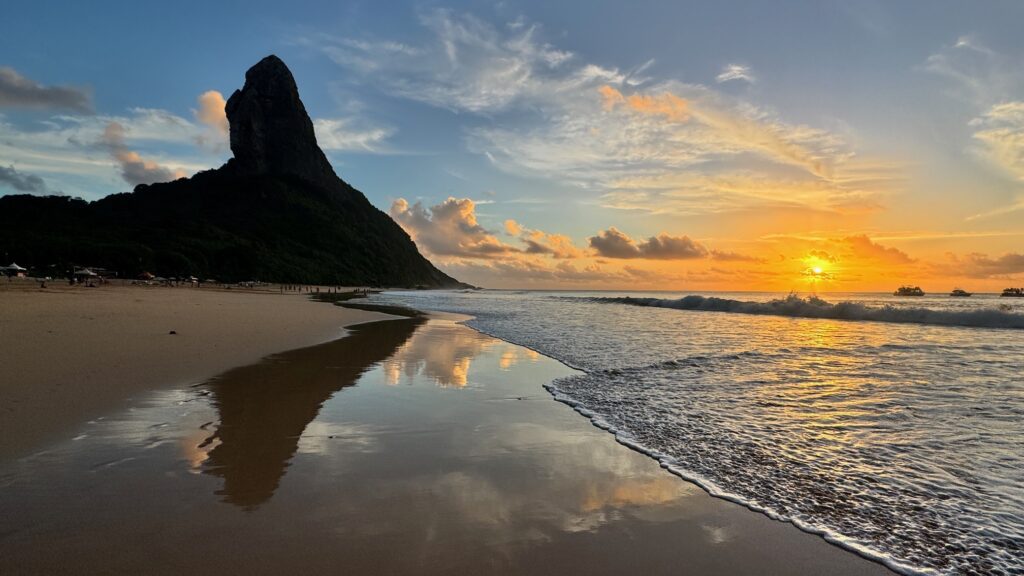
Image: Iconic Morro do Pico at Praia da Conceição, Fernando de Noronha, Brazil.
Highlights
– Fernando de Noronha is a tropical island destination with golden sand beaches, blue waters, wildlife and other adventure opportunities off the coast of Brazil.
Time of Visit: May 2026
Duration of Visit: Five Nights
Description
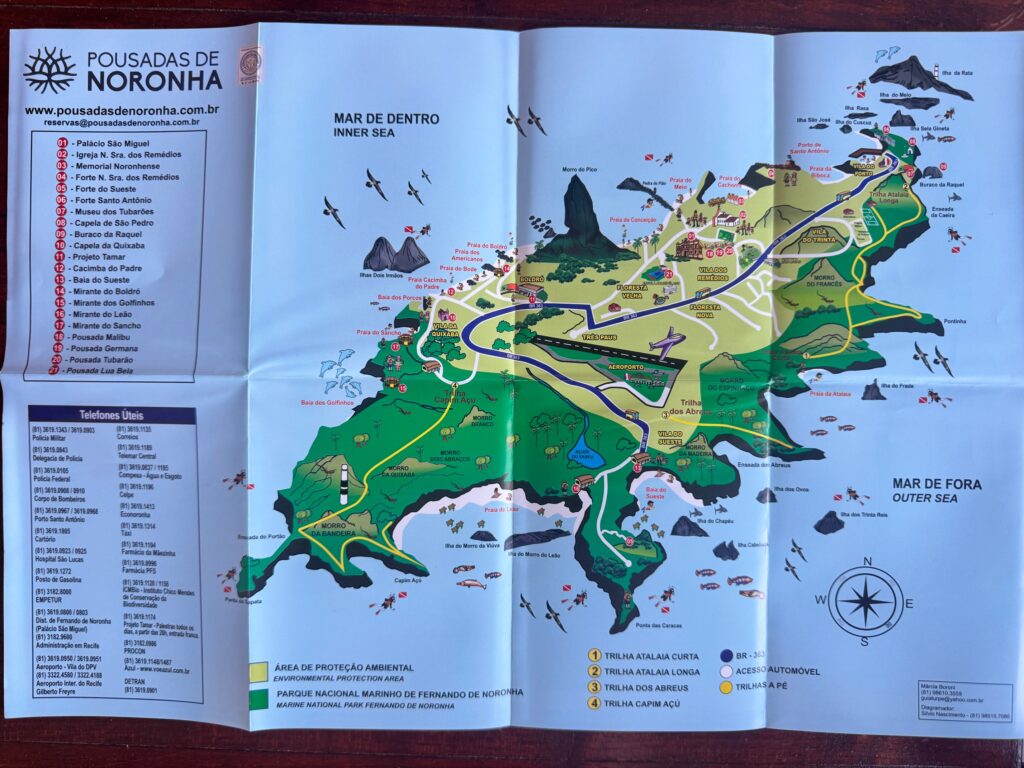
Fernando de Noronha is a volcanic archipelago located roughly 220 miles off the northeastern coast of Brazil. The archipelago has a main inhabited island and surrounded by smaller, uninhabited islands. The main island is approximately 10 kilometers (6.2 miles) long and 3.5 kilometers (2.2 miles) wide at its widest point.
Fernando de Noronha is a UNESCO World Heritage Site and a Marine National Park. Access to the archipelago is strictly regulated to preserve its fragile ecosystem. There is a limited number of flights per day from mainland Brazil to the main island which essentially caps the number of daily visitors.
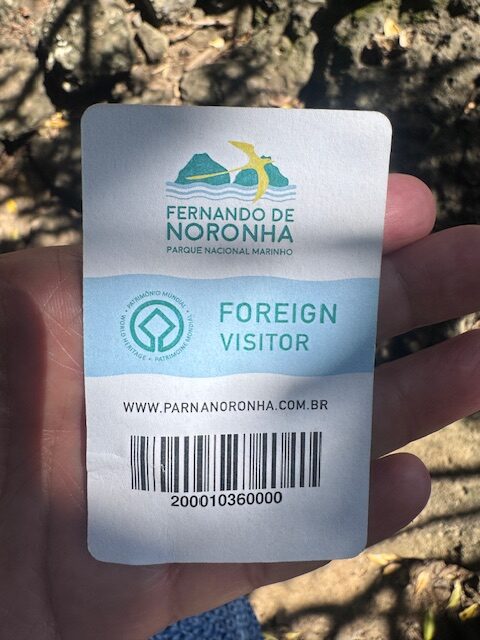
Perhaps, Fernando de Noronha is the most expensive destination in Brazil. Everything needs to be flown or shipped in which drives up the price of everything. Additionally, every visitor needs to pay a daily environmental fee. Some of the most popular places on the main island is located within the National Park which requires the purchase of a 10-day pass.
But do not let the cost deter you from visiting Fernando de Noronha. The archipelago blends raw beauty, abundant wildlife, friendly locals and laid back atmosphere. Even though most of the recreational activities is restricted to the main island, there is certainly a lot do and enjoy than just laying on the beach.
Activities
Beaches
Fernando de Noronha is blessed with several beaches with golden sand and different shades of blue and green water. However, during our visit, the waves were too big and strong to safely swim. In a clockwise direction starting from the island’s north end, we visited Porto, Sueste, Leão, Sancho and Cacimbas do Padre and Conceição.
Praia do Porto
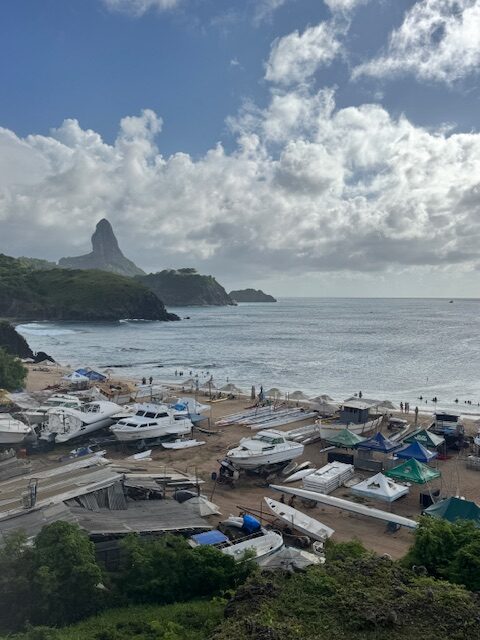
Praia do Porto is at the north terminus of the island’s main road – BR 363. It has the calmest beach and the best snorkeling site. There are colorful fishes, particularly different species of parrot fish. Big green turtles feeding on the ocean floor were very common. We even saw a baby shark and stingrays. The water of Praia do Porto is not the clearest but is still sufficient to see the different sea life mentioned. A park pass in not needed to access Praia do Porto
Sueste
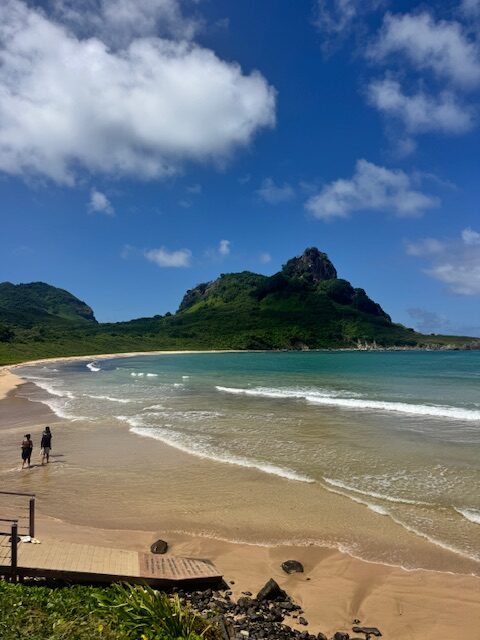
At the south end of BR 363 is Praia do Sueste. The beach area is the nursery for small baitfish which attracts feeding juvenile sharks. As such, swimming is not allowed. Visitors are allowed to wet their feet in the water for a closer look of the juvenile sharks but no deeper than above the ankles. A park pass is needed to access the beach.
Leão
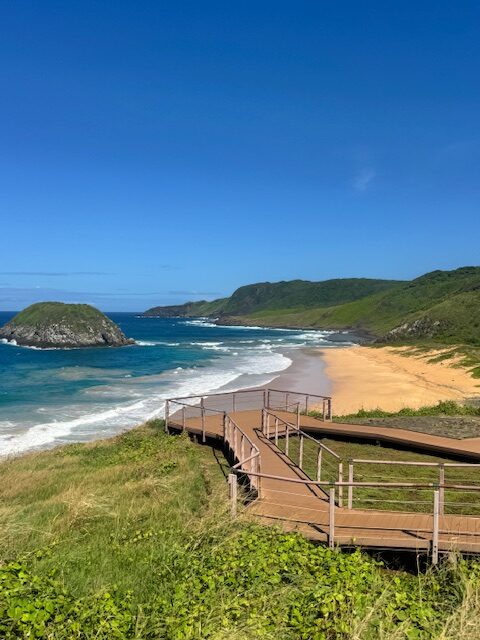
Leão probably has the best view among the places we set foot on the main island. The beach is reachable by a 1.1 km (0.7 mi) dirt road from BR 363 followed by a 300 m (1,000 ft) rocky downhill trail with 165 m (540 ft) descent. A park pass is required to access the beach.
The pristine beach is empty. The park ranger said that people can bring umbrellas and chairs to the beach, assuming one is handy enough to carry it down and back up. The waves were strong even during low tide during our visit so swimming was not allowed. There is a natural pool in the beach’s north end which is a hangout spot for some juvenile sharks.
Sancho
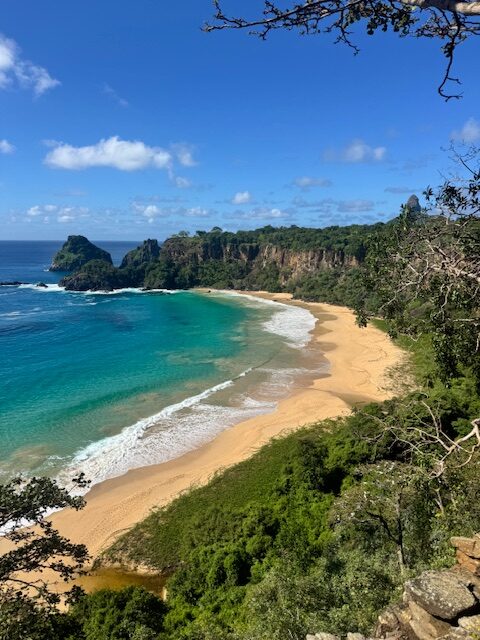
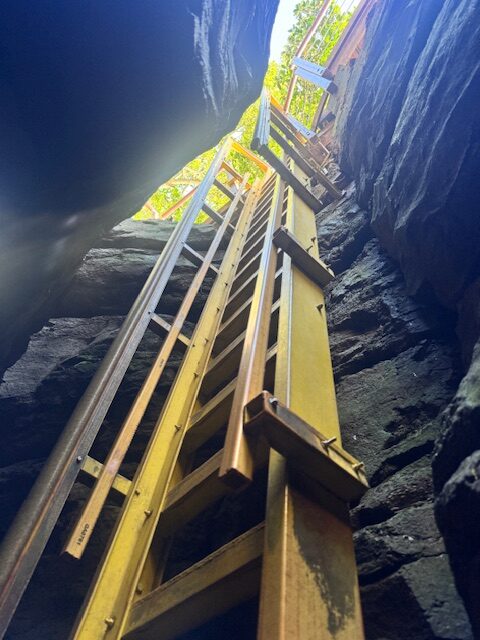
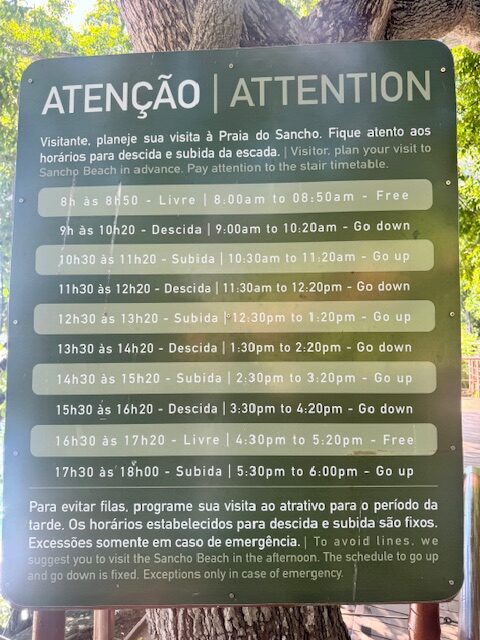
Sancho is a multiple time winner as the #1 Best Beach in the World in the annual Tripadvisor Traveler’s Choice Awards (we do not agree). It is located within the national park. Sancho is a special beach as it has a couple of things that are unique. First, access to the beach can only be done by using a fiberglass ladder. Because the ladder only provides a one way access, the park has strict alternating descending and ascending times that are normally 50 minutes long.
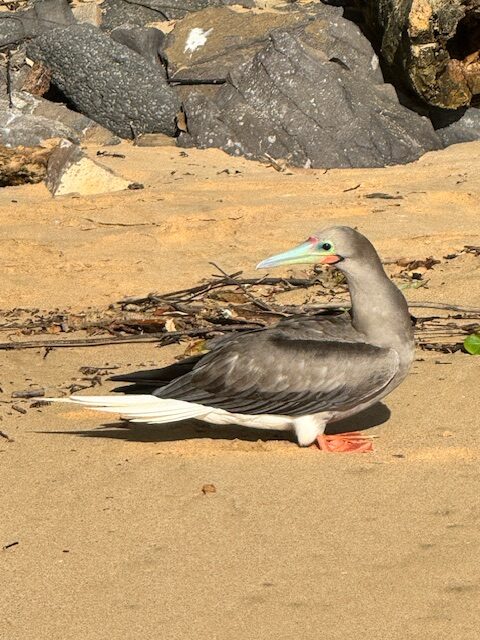
The second unique aspect of Sancho was the wildlife. It is common to see juvenile and nesting red footed boobies among the trees, an agouti (a smaller version of the copybara) among the rocks and maybe a stingray or shark in the water.
Cacimba do Padre
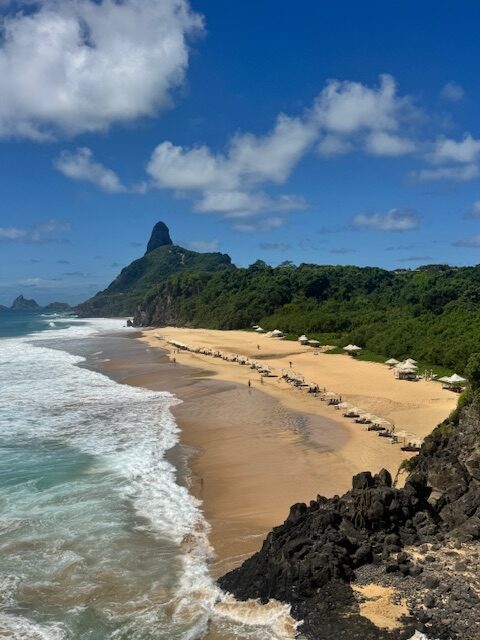
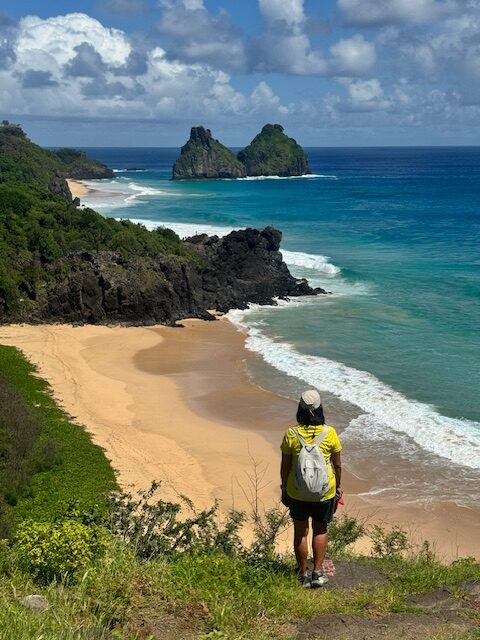
Cacimba do Padre is like any other beach on the island. But its proximity to the jutting rock formations called Dois Irmaos makes it one of the more popular beaches. The waves were too strong to swim in but the scenery makes up for it.
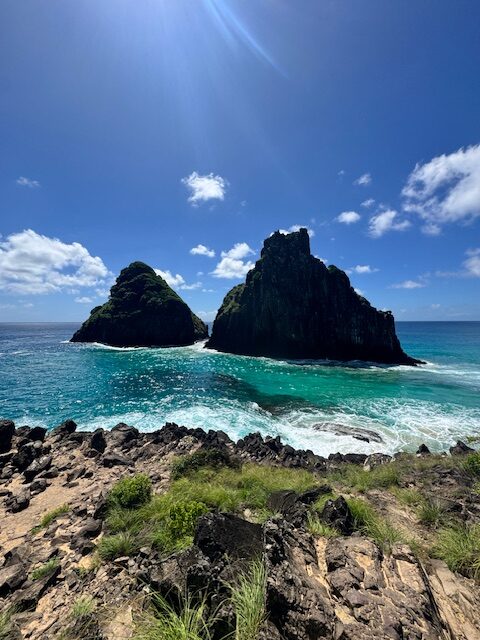
Mirador dos Dois Irmaos, between Praia dos Porcos and Cacimba do Padre is a popular stop for land tours. So the place gets crowded around noon 11 AM to 1 PM. But after 2 PM, you may have the viewpoint all to yourself. And some of the photos showcasing the island’s beauty features that location, especially during sunset. A park pass is not required to access Cacimba do Padre.
Conceição
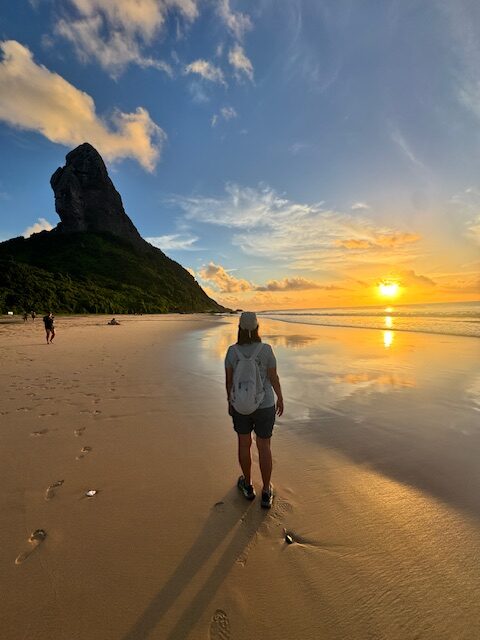
Praia da Conceição along with the Dois Irmaos rocks mentioned earlier are the island’s poster children whenever you type “Fernando de Noronha” in Google. Conceição has the same golden sand beach as other beaches on the island. But what makes this beach popular is the Morro do Pico which is a volcanic rock formation standing approximately 323 m (1,060 ft) above the beach. This rock formation is the island’s most recognizable landmark and is visible from many locations. The beach is a popular place to take sunset photos. A park pass is not needed to access Praia da Conceição.
Hiking
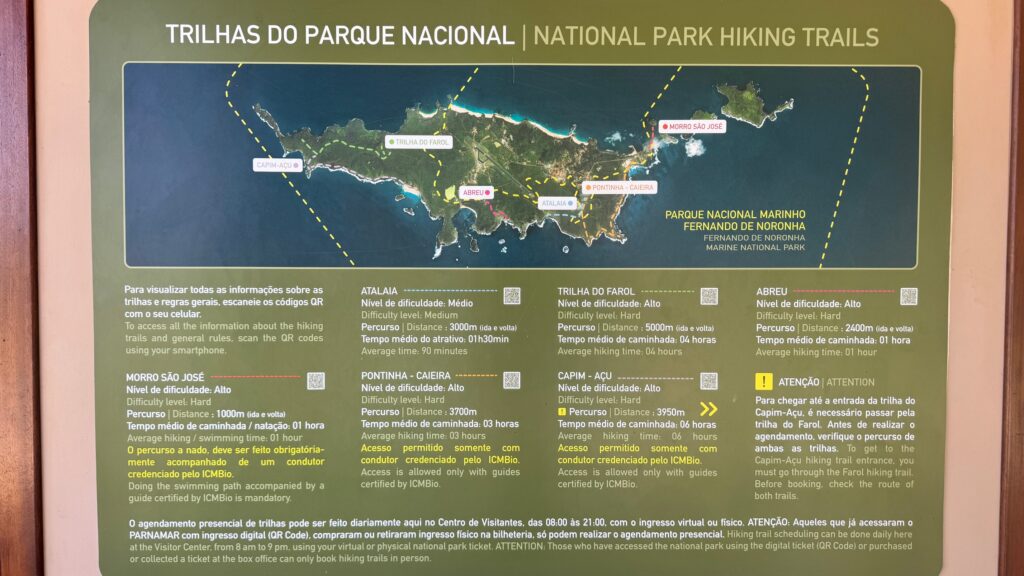
Fernando de Noronha has hiking trails. Some are in the National Park and some are not. The hikes are just short distances. The most sought after trails are in the National Park. There are four hikes in the park that have daily limits. These are Atalaia (short and long), Abreus and Capim Acu. People who wish to go need to sign-up before doing the hike. The Atalaia (long) and the Capim Acu require a guide which you have to hire. Atalaia (short) and Abreus have natural pools which makes them in high demand. Each has its own specific rules and daily limit.
We were only able to do three hikes – Alataia (short), Trilha Dos Golfinhos – Sancho and Ponto do Caracas with Forte de Sao Joaquim. These hikes are described here.
Abreus and Atalaia Tide Pools
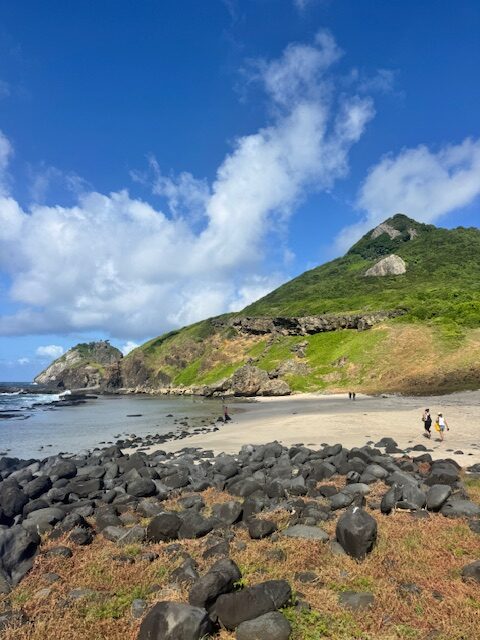
It is best to sign-up as early as you can as slots are limited. Atalaia (short) only allows 10 people every 30 minutes while Abreus’s limit is six at a time. These two hikes lead to natural pools hence the limit to prevent overcrowding and preserve the ecosystem. Access to the natural pools is only allowed during low tide – three hours before and three hours after.
We were only able to secure one slot for Atalaia (short) and none for Abreus (the two that we wanted to hike). You will need your park pass ticket to sign up for the trails which can only be done at the Centro de Visitantes where you buy the park pass. A QR code is generated when you avail of a slot. So our suggestion is to sign up right after you purchase the pass.
The earliest entry for Atalalia (short) is 7:30 AM. Sometimes only one group of people is allowed for the day because the low tide occurred at dawn.
The hike is 1.1 km long on a natural stone path on a slight downhill. Sturdy shoes are recommended but certainly hikeable with sandals if dry. The park ranger at the trailhead (shown on Google Maps) checks the sign up QR code.
Atalaia natural pool is shallow and a personal floatation device (can be rented at the entrance) is mandatory. The park does not want visitors to touch the bottom to protect the fragile and scant corals. Snorkeling is the main activity as there are colorful fishes that call the pool home. They are found mainly hiding under the rock undertoes.
If you are the last group for the day (ask the ranger beforehand), make sure you allot enough time to get ready to leave. The ranger will run you off whether you are ready or not as they don’t want to stay any longer than they have to because there is no shade there.
Trilha dos Golfinhos-Sancho
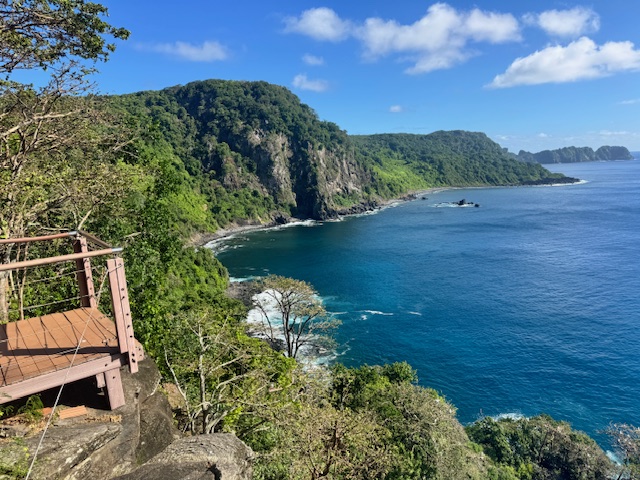
The trail between Praia Dos Golfinhos and Praia Sancho is above the beach and parallels the cliff edge. It has some viewpoints of the wonderful scenery below. The trail is through the forest with the majority shaded.
I saw a few big monitor lizards (about a meter long or 3 feet) along the trail. These reptiles immediately scurried out of the trail when they heard me approach so I was not able to get any photos.
At the viewpoints, you will also have the chance to see a lot of young juvenile seabirds roosting on the tree canopy.
Ponta das Caracas and Forte Sao Joaquim
These short hikes are well worth the effort. Best to do the hike as early as possible to escape the heat. Although the destinations are inside the park, there was no Ranger checkpoint at the trailhead.
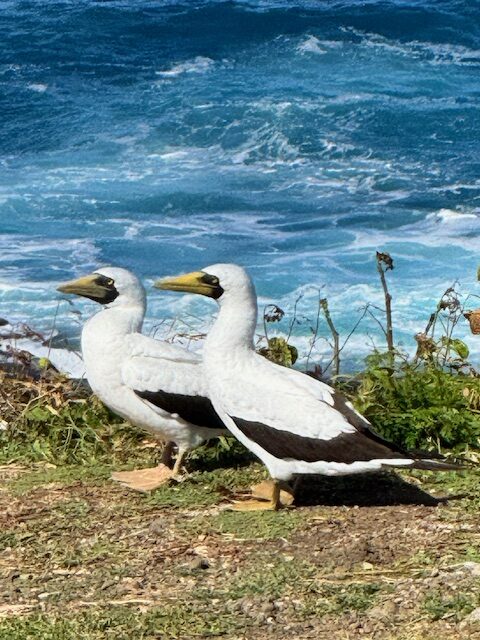
Ponta das Caracas has the colliding waves and a natural pool. We also saw a couple of masked boobies nesting here.
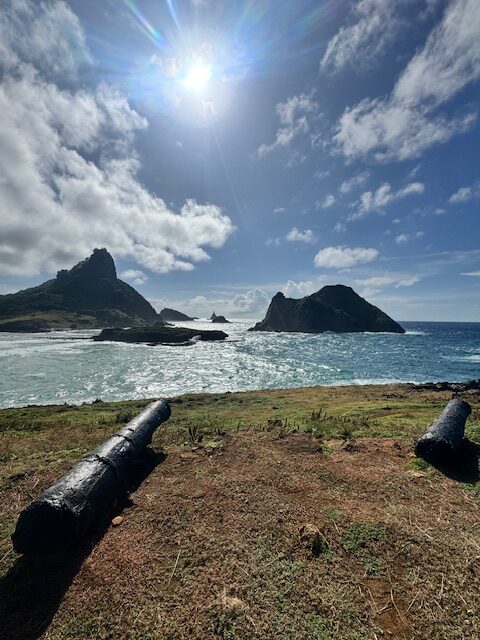
Only the rusted cannons at Forte Sao Joaquim remain. The structure is no longer there. But the view of Praia Sueste and the islets at this part of the island is really beautiful.
Tours
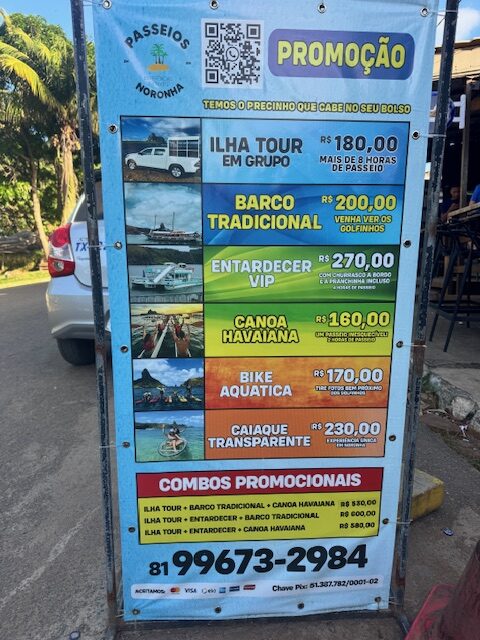
Several tours are available on the island. The most popular are the land tour and boat tour. We only signed up for the land tour which lasted about eight hours (from picking up the first passenger to dropping off the last one). So even if the tour is advertised as eight hours, its actually about seven between the first stop and the last. We were picked around 8:45 AM as we were the second to be picked up and dropped off around 4:15 PM as the last to be dropped off.
It seems the land tours go to the same places which are some of the must visits on the island. We hit the following: Praia Sancho, Praia Cacimba do Padre, Baia Sueste, lunch break at a restaurant (not included with the tour price), Mirador do Frances, Enseada dos Tubaroes and Praia do Porto.
In our opinion, do the tour if you do not like to walk, otherwise skip it as all destinations are accessible by bus and walking. Then you are in control of your time. For example, at Praia Sancho, there was no opportunity to hike the Trilha Golfinhos – Sancho as the tour’s destination was only the beach and the viewpoint of Dois Irmaos above Praia do Porco.
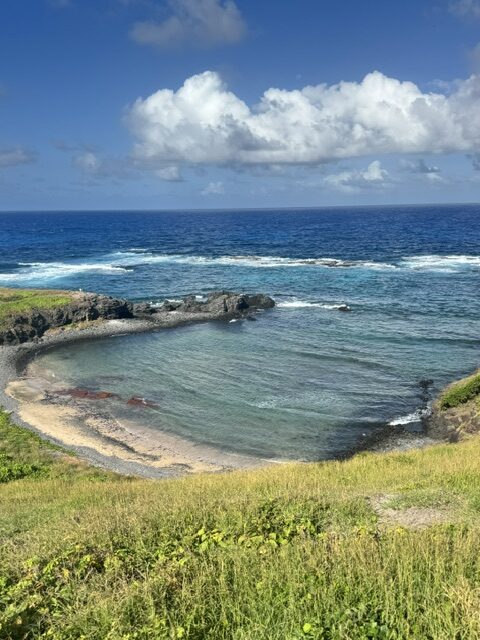
There was not much to see at Mirador Frances except you can say you are at the northernmost tip of the main island. Enseada dos Tubarões was certainly interesting as we saw several large sharks in the shallow bay. Baia Sueste and Praia do Porto are just a short walk from the bus stop. The rest require about 15 to 20 minutes of walking from the closest bus stop.
Tips
Brush up on your Portuguese or at least have an offline translator. We found that English speaking locals are common at Pousadas and souvenir stores. Everywhere else, it’s only Portuguese, even at the visitor center and the tour.
If you plan on walking a lot, bring sturdy but comfortable sandals. Shoes are great but if you have to walk a muddy road, you’ll wish you left your shoes behind.
Sunscreen and insect repellents are a must. The sun was intense and almost everyone we saw have insect bites, including us.
How To Get There
The only way to reach the island commercially is to fly. The island has a domestic airport, code FEN. It seems all the flights that go to the island pass through the city of Recife (airport code REC). A flight from Recife is also the cheapest. The flight time takes just over an hour.
Where To Stay
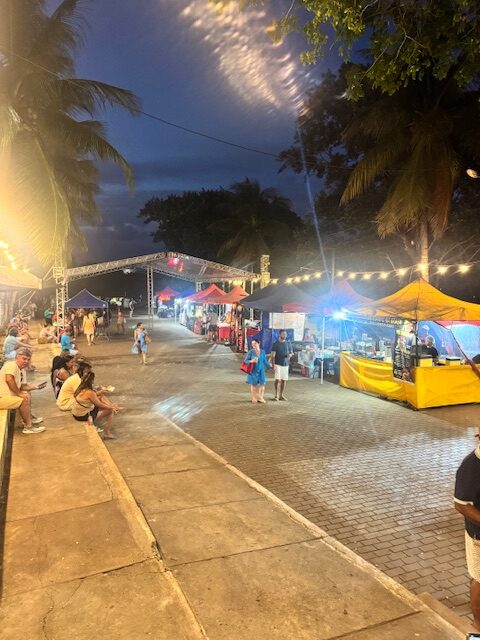
Most of the accommodations on the island are called pousadas, which is like a hotel room. There are pousadas almost everywhere. We stayed at Pousada Tubarao which is at the community of Vila dos Remedios. Shops, a couple of mercados and lots of restaurants are nearby. Praia da Conceição was a 20 minute walk. And there is a bus stop a minute away.
Realistically, you can stay anywhere in the island as long as you are not far from a bus stop.
How To Get Around
Buses

There is only one bus route and it travels between Praia do Porto to the north and Praia Sueste to the south along the island’s main road – BR 363. There are two buses running in opposite directions. Each leaves the start point on top and at the bottom of the hour. There are designated bus stops but the driver will stop if you hail one even if you are not at a bus stop. The trip in one direction takes 25 to 30 minutes.
There are two bus stops that are away from the main road. One is in front of Supermercado Poty (shown on Google Map) and the other is not far from Hotel do Transito (also shown on Google Map). The latter stop cuts the walking time to Praia dos Cacimbas.
Taxis
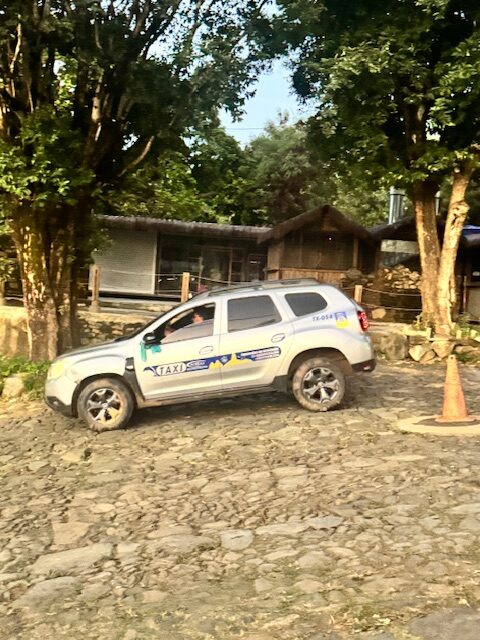
Taxis are common along the main road and at Vila dos Remedios. They take people almost anywhere on the island that has a road, even if it’s unpaved and rugged as long as they can drive on it safely. However, rates can be expensive.
We did not use taxis as we prefer walking but we were told that some accept credit cards while others only take cash.
Buggy Rentals
There are several businesses along BR 363 that rent buggies. We did not inquire about the cost but we heard it was quite expensive.
Expected Expenses
TPA (Environmental Fee) – 104.10 BRL($20 USD) pax per day, credit card accepted. Can be bought online but transactions with our US credit card would not go through.
Park pass (foreigner) – 384 BRL ($77 USD) pax, good for 10 days, credit card accepted. Can also be bought online but has the same issue as TPA.
Local bus – 5 BR, cash only.
Tours – see photo. It pays to shop around as not all tours are priced the same. We thought ours was fair. The pousada’s concierge quoted a much higher land tour price that included sunset which we thought did not justify the price difference.
Beach umbrella with two chairs and a small table – 100 BRL ($20 USD) for the entire day up to 5:30 PM.
PFD Rental at Atalaia Trailhead – 30 BRL, cash only.
Taxis – see photo
Stay Informed
If you want to be notified when we post a new travel story, please enter your email below. We respect your privacy. Your email is used only to notify you of new posts and is never sold or shared with third parties. You can unsubscribe at any time.
Summary
Fernando de Noronha is a must visit in Brazil. It is probably the most expensive destination but certainly well worth the cost. The island vibe reminds us of the Galapagos and Rapa Nui.
The beaches are not white sand and the waves may be too strong for swimming, but renting a beach umbrella and lounging on a chair while enjoying your favorite food or drink makes it very relaxing. Best of all, the beaches are never crowded and some are downright empty.
The island also provides some unique experiences. Where else would you have to go down a ladder to get to a beach. Beautiful seabirds abound like the red footed boobies and long tailed tropic bird. And snorkeling in a tide pool teeming with colorful fishes is not an everyday opportunity.
Overall, we liked Fernando de Noronha and were quite sad to leave the island after just five nights. Given the chance in the future, we will definitely be back to see the rest of this wonderful island.