
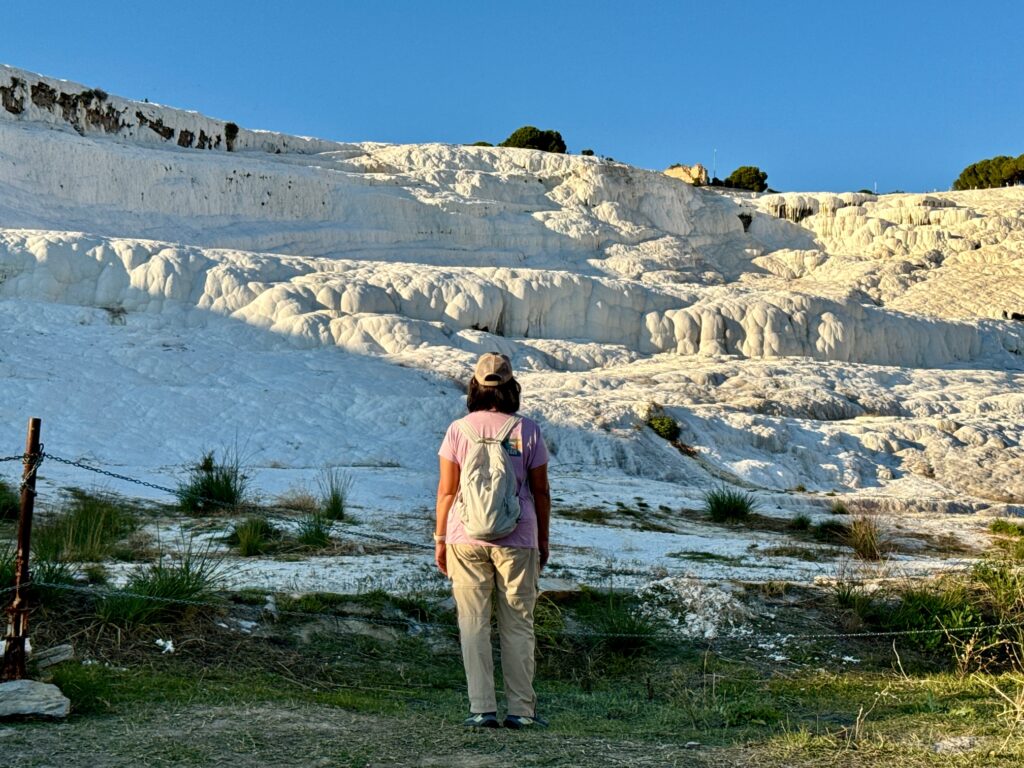
Image: The rounded white travertine formations covering the hillside give rise to the name Cottoncastle.
Highlights
– Your ultimate guide in visiting the Pamukkale Cottoncastle, Hierapolis Ancient City and blue Salda Lake in central Turkey.
Time of Visit: October 2025
Duration of Visit: Two Nights
Description

Pamukkale is a Turkish word that means cotton castle. It is derived from the white travertine formations that literally cover a hill side so it appears like a castle made of cotton. While most people’s vision of Pamukkale are the white terraces filled with turquoise water, the place is more than just travertine deposits and water.
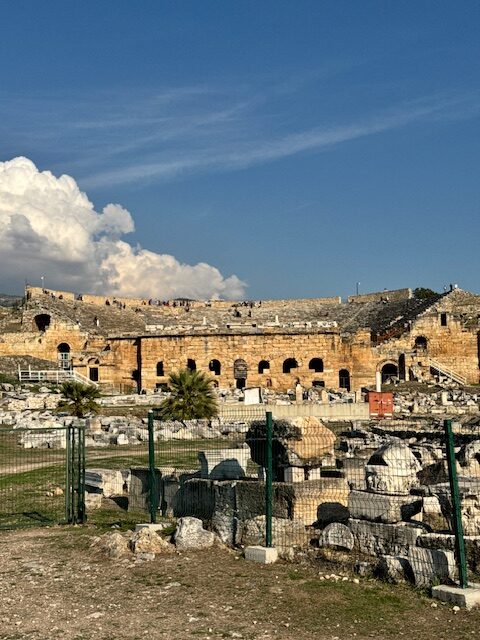
On top of the hill and adjacent to the white terraces is the Hierapolis which is a UNESCO World Heritage Site. Hierapolis has remains of an expansive Greco-Roman city with a large necropolis, a huge theater and numerous structures that are still partially standing. It is also believed to be the final resting place of St. Philip, one of the twelve apostles.
Within the Hierapolis, there is also Cleopatra Antique Pools which is a historic thermal pool filled with warm, mineral-rich water and submerged ruins from an ancient Roman temple. The pools offer visitors a unique swimming experience amidst history and relaxing atmosphere. Unfortunately the pools were closed during our visit and was not able to enjoy the attraction.
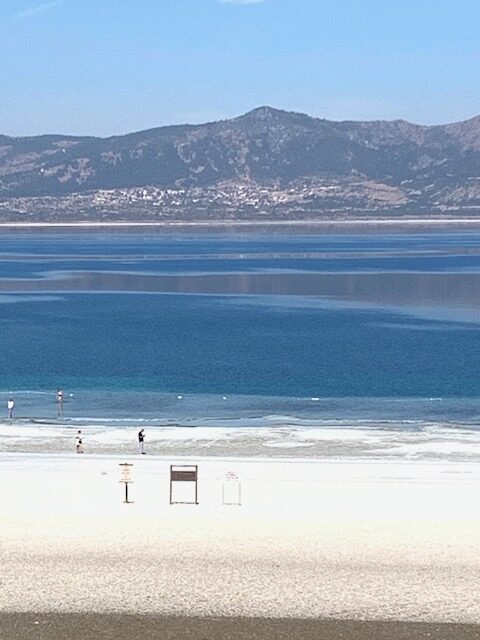
About an hour and half drive from Pamukkale is the Salda Lake which is a deep, clear crater lake that has turquoise water and white sand beaches. The water is calm and very inviting for a swim. It is a popular place to cool off during the summer. Salda Lake makes for a nice day trip from Pamukkale. We stopped at Salda Lake on our way to Sagalassos Ancient City which is about an hour away from the city of Isparta.
Here we provide useful information such as where to stay, how to get there, activities and expenses to help you plan your visit to Pamukkale and Hierapolis.
Activities
Cottoncastle
There are several white travertine terraces filled on the hill’s southern slope. But most of the terraces are dry or off limits to visitors. There were only about a dozen or so terraces that had water where people can wade in.
Most of these water-filled terraces are located on top of the hill where the spring is located or at the bottom by the town entry gate.
How To See The Cottoncastle
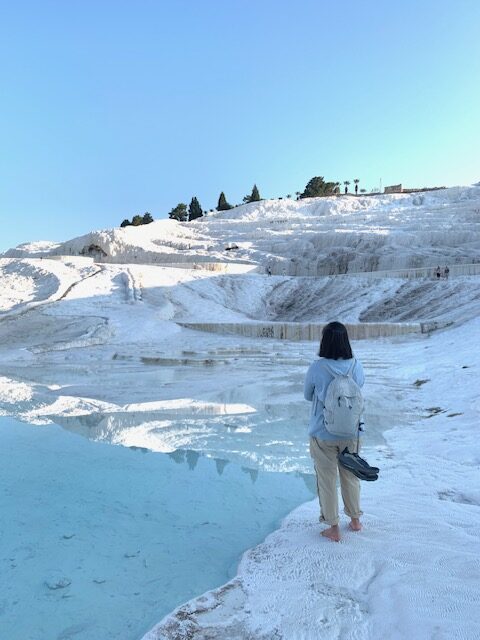
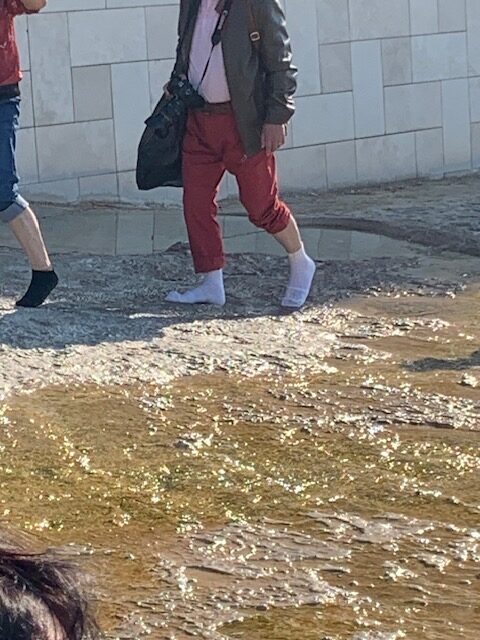
Visitors are allowed to walk barefoot on the travertine surface. It is quite uncomfortable to do so but those are the rules – no shoes or slippers when walking. Also, near the spring source, there are slippery surfaces because of moss. We saw a couple of people slip and fall in this area.
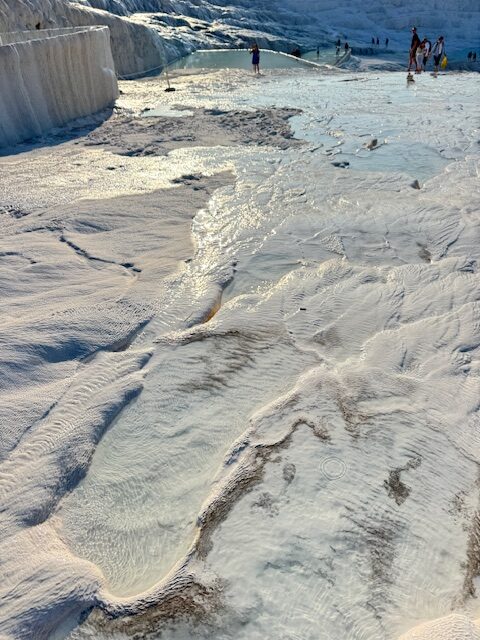
Most visitors access the Cottoncastle from the South Gate which is at the top of the hill. Most of them only stay in the upper part of the mountain where they can get to about three waterfilled terraces. We entered from the town entrance which is at the base of the hill and walked up. There were less people here but it also has terraces filled with water.
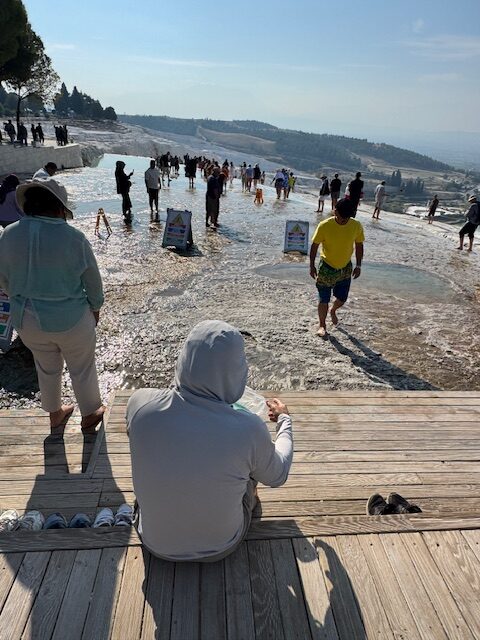
Hiking up to the top of the hill from the town gate was not difficult at all, only uncomfortable for the feet because of the hard and uneven travertine surfaces. The cold water flowing over the travertine surface does numb the feet a little such that it becomes less uncomfortable to walk up.
Though the uphill walk may look steep, we moved really slow being barefoot. Therefore, we were not really exerting much effort. Also, the travertine surface was grippy even with a thin layer of cascading water. It took about an hour to get up to the top of the hill and the spring source, including time to take photos.
Do’s and Don’ts
Best Time
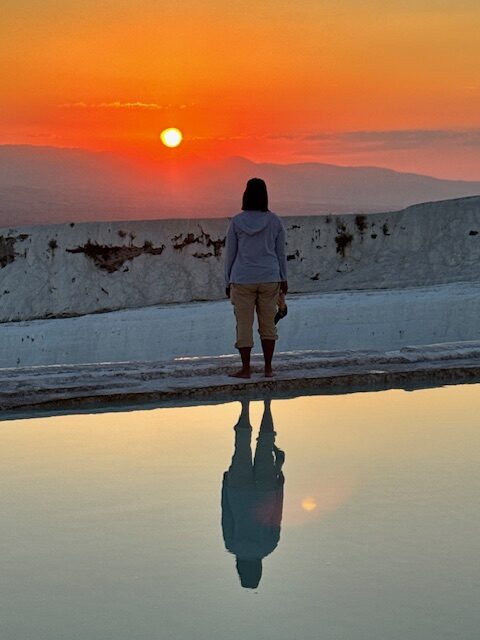
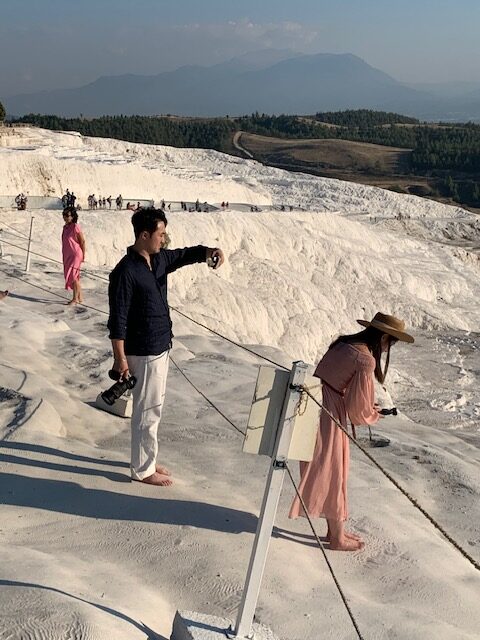
Morning and sunset are the best time to explore the Cottoncastle. Mornings have fewer people and this is also the time the hot air balloons are launched. Sunset provides vibrant colors in the horizon even though the hillside faces Southwest. We also saw paragliders in action in the afternoon.
Re-entry
Unfortunately, there is no re-entry privileges. This would mean a long day if you want to be there in the morning and at sunset.
Fortunately, there is the Hierapolis to explore and pass the time while waiting for sunset. Bring your lunch or buy at the on-site restaurants so you wont get hungry during the long day.
Hierapolis
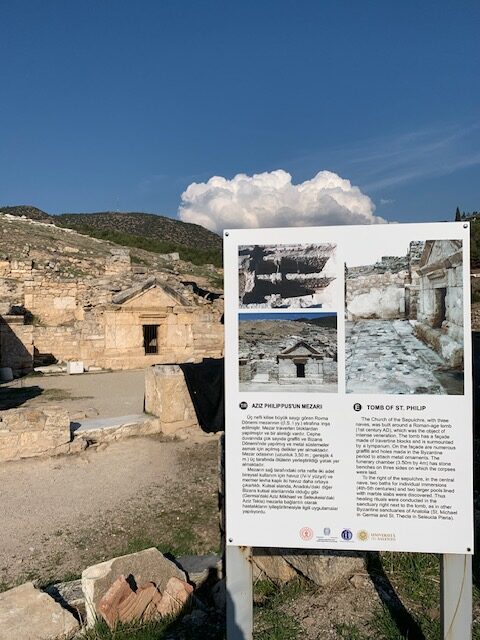
Prior to visiting Pamukkale, we were not aware that there is the Ancient City of Hierapolis on the same hill as the Cottoncastle. So once we entered the town gates, we had access to both the Cottoncastle and the archeological site.
The site is huge but mostly in ruins. There are a few interesting structures that are still standing and worth spending time on. These are the necropolis, the Roman Gate and the theater. There is also the tomb of St. Philip, the Apostle.
Necropolis
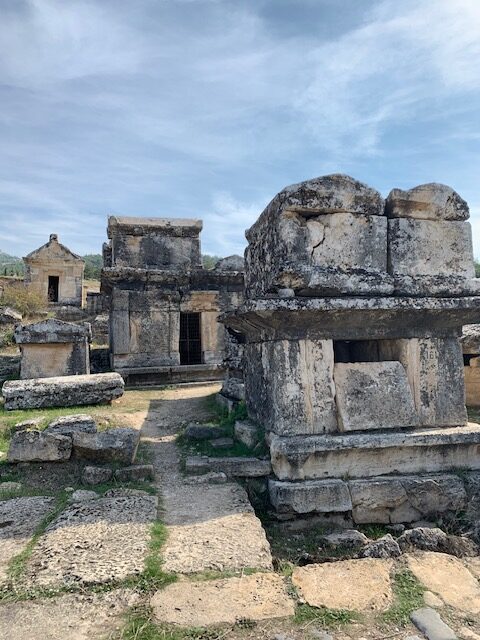
The necropolis is a large area. There are over a hundred stone tombs and maybe a thousand or more sarcophagi. What is interesting is that some of the sarcophagi are placed on top of the tombs or built-up platforms. This was done for three reasons.
First was for protection and preservation. Hierapolis was prone to flooding and mineral deposits from the nearby hot springs. Second was status and visibility. The higher the tomb or sarcophagus, the greater the prestige it symbolized. Third was architectural stability. Many of these stone platforms also housed family burial chambers or ossuaries below, while the sarcophagus above marked the resting place of the principal family member.
Roman Gate
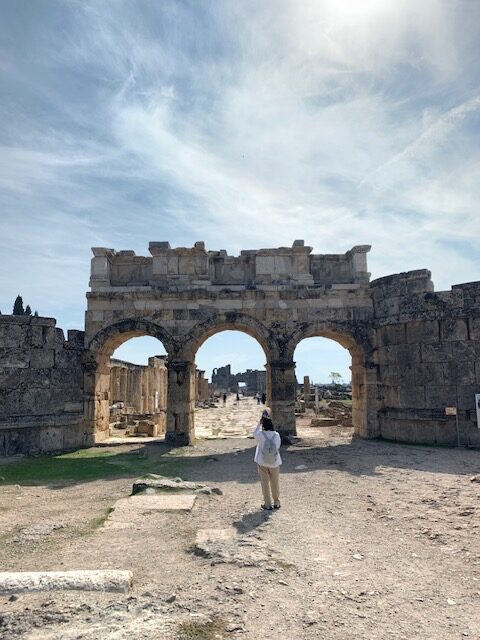
The Roman Gate is a triple arched gate that is flanked by two towers. The gate served as the main entrance to the city. It is also known as Domitian Gate named after emperor Domitian who reigned between 81-96 AD. The gate is also known as the Frontinus Gate because it was built by Julius Frontinus.
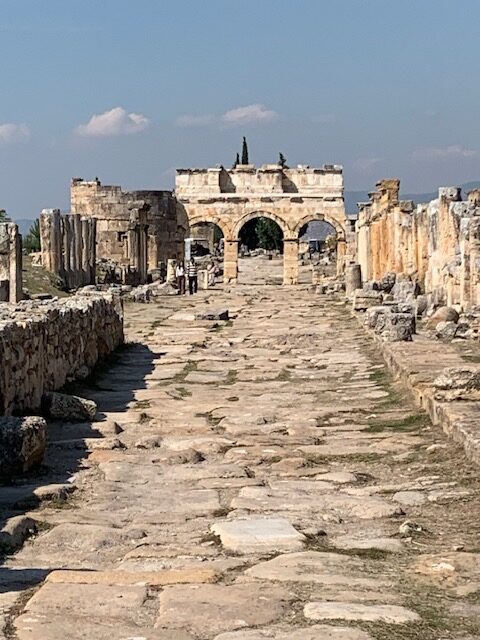
The Roman Gate marks the start of Frontinus Street which is a colonnaded street made with travertine slabs. Most of the street is intact and some of the columns are still standing. Walking through the gate and on Frontinus Street is like walking back in time.
Theater
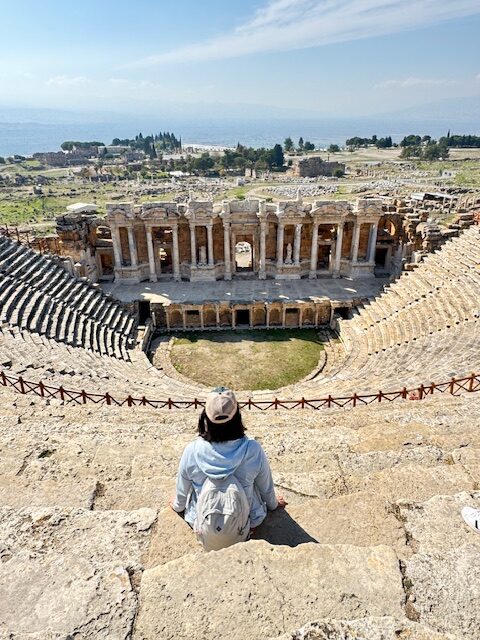
The Roman Theater at Hierapolis is a remarkably preserved 2nd-century structure. The theater was carved into the hillside, has ornate marble decorations and seats about 15,000. This theater is one of the largest we saw in Turkey.
The theater is located at a higher elevation than most of the ancient city thereby providing a commanding view when standing at the bleachers.
Museums
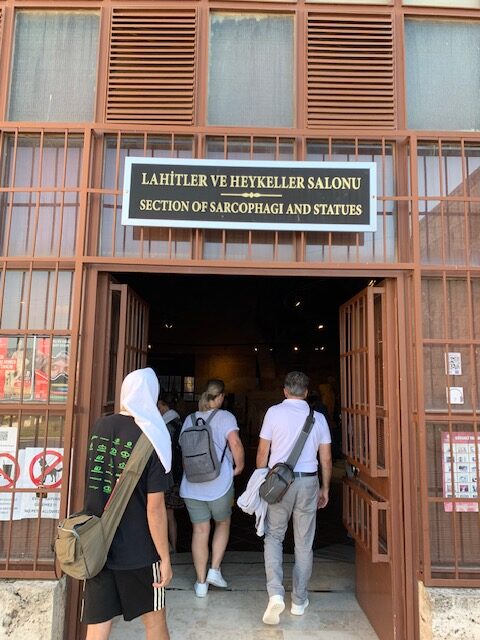
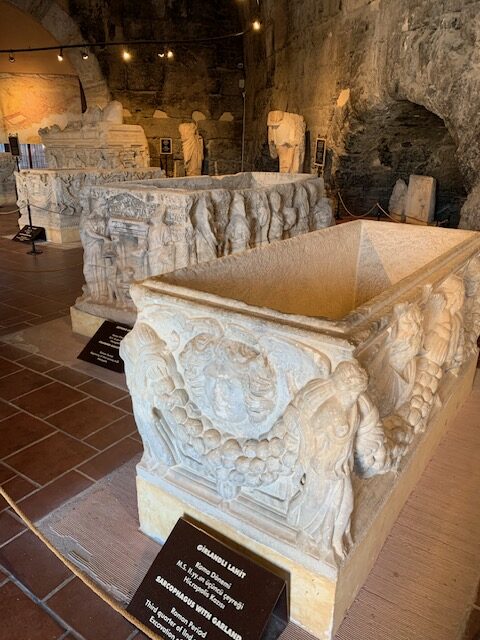
There are three enclosed museums just a stone throw away from the spring on top of the hill. The museums showcase sarcophagi, small relics such as coins and statues. These were moved to the museums so that it is protected from the environment.
Do set aside about an hour or more in exploring the museums before heading back to the terraces for the sunset.
Other Activities
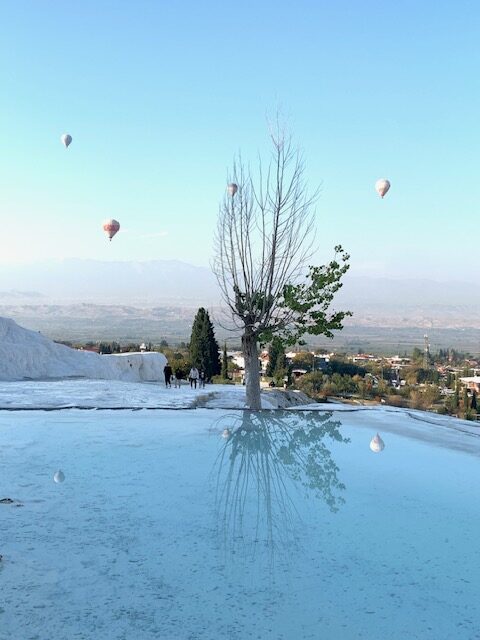
Hot air balloon ride and tandem paragliding are other activities that can be done in Pamukkale.
Salda Lake
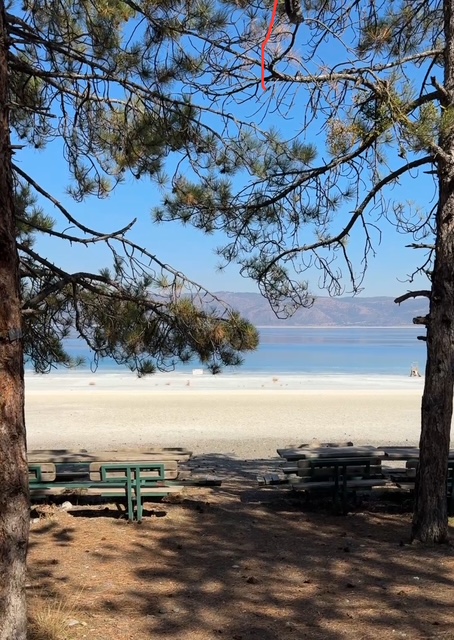
Salda Lake was a nice getaway from the chaos of being around many people in Pamukkale. The calm, turquoise water and the tranquility of the area was a nice change.
But this lake does get its fair share of people during the hot summer months.
Salda Lake Park has picnic tables, a restaurant, restrooms and changing rooms.
How To Get There
We drove ourselves from Bergama to Denizli. The drive takes about four hours
We saw tour buses as well. If you are taking public transportation, the Obilet app is what is generally used to get around Turkey.
Where To Stay
We stayed in the small town of Denizli which is at the base of the Panukkale hill. Our AirBnB was located at the center of town and just took about 15 minutes to walk to the town entry gate.
You will need to drive yourself up if you want to enter at the South gate which is on top of the hill.
How To Get Around
We just parked our rental car at our accommodation and walked all day to explore Pamukkale and Hierapolis. There are benches and grassy areas within the park that are perfect for taking naps. There are also golf carts that some visitors hire to take them around Hierapolis.
Expected Expenses
Museum Pass

Consider purchasing a Museum Pass if you plan on seeing a number of historical and cultural sites in Turkey. There are several passes to choose from. There is the Turkey Pass which is valid in all the sites in Turkey for 15 days. There are also the Mediterranean, Aegean and Cappadocia Passes which are area dependent.
We did not completely research what we intended to visit and purchased individual site entry fees. In the end, we ended up spending 15 Euros more per person between Ephesus in Selcuk, Akropol in Bergama and Pamukkale instead of purchasing the Aegean Pass. Above is a list of sites where the Aegean Museum Pass is valid (as long as you can do it within seven days).
Entry Costs
Pamukkale/Hierapolis entry fee – 30 Euros (amount charged is in TRY). Entry fee is only good for one day.
Salda Lake Park – 50 TRY per vehicle.
Summary
Pamukkale is a popular tourist destination because of the otherworldly “Cotton Castle” landscape that is made of brilliant white travertine terraces. The terraces are formed by mineral-rich thermal waters which create stunning natural pools perfect for bathing and photography.
Visiting Pamukkale also provides access to the ancient ruins of the Greco-Roman city of Hierapolis which is a UNESCO World Heritage Site. These include a large theater, a vast necropolis, the Roman Gate and the famous Cleopatra Ancient Pools.
Salda Lake, a clear crater lake with calm turquoise water and white sand beaches is a nice day trip from Pamukkale. Visiting this lake during the off season is a nice change in scenery and allows you to get away from crowds. There is no doubt that Pamukkale should be on a bucket list. It is truly a unique destination. There are other places on earth that have travertine terraces like the Minerva Terraces in Yellowstone National Park, USA or Hierve El Agua in Oaxaca, Mexico, but none of them compares to the scale and grandeur of Pamukkale. Seeing this part of Turkey is an unforgettable experience where geothermal wonders meet classical antiquity, making it a must-see.