
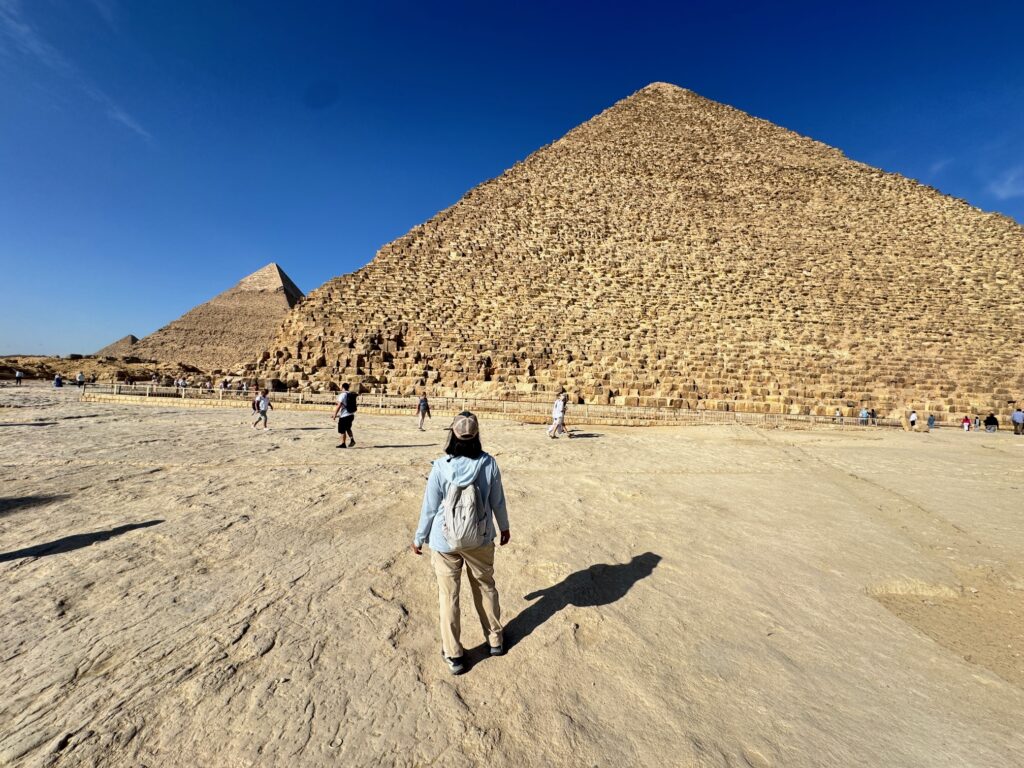
Image: The Three Great Pyramids of Giza, Egypt.
Highlights:
How to see the newly opened Great Egyptian Museum (GEM) and The Great Pyramids in Giza, Egypt.
TIme of Visit: November 2025
Duration of Visit: Two Nights
Description
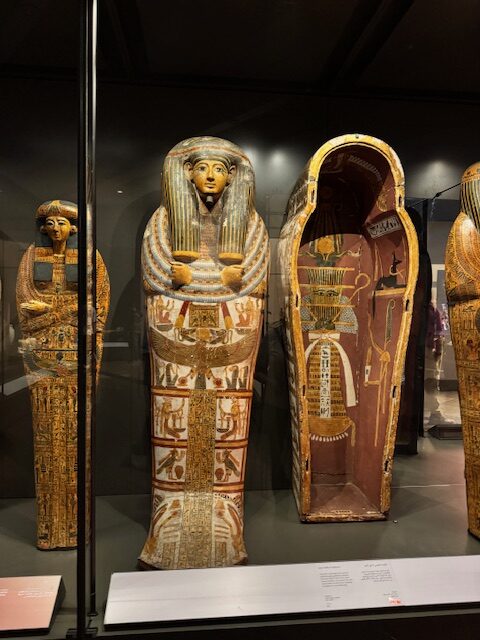
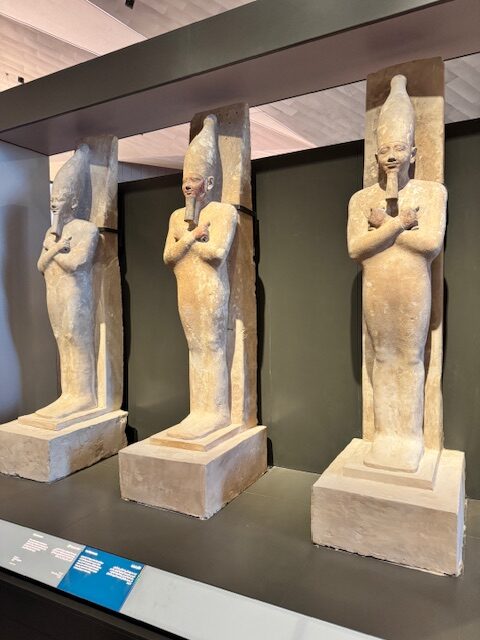
The Great Egyptian Museum (GEM) opened in late 2025. The museum grounds are still under construction but the exhibits are open for public viewing. This museum is huge and houses thousands of artifacts collected from different archeological sites. You will find collars worn by pharaohs to statues and vases and almost anything in between that provide a glimpse of the ancient Egyptian world. Undoubtedly, the museum’s greatest attraction is the Treasures of King Tuthenkamun or King Tut which you would only find here.
GEM is worth the visit even if you have visited archeological sites such as those found in Luxor or in Abu Simbel. Though some of the displays are similar to what can be seen at archeological sites, the museum is not a substitute for those sites and vice versa. There are just so many unique displays here. We spent over five hours touring the museum. Except for the King Tut exhibits, we did very little reading of the short posted information about the displays. It would be easy to spend an entire day in the museum if you are the type that likes to read display information.
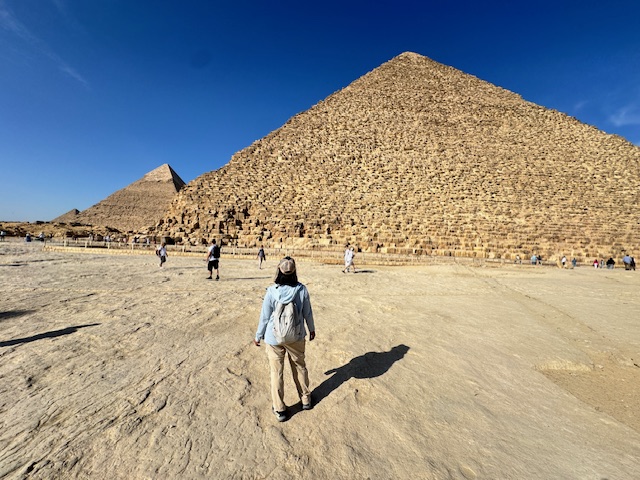
The iconic Pyramids of Giza are truly a wonder of the ancient world. Within Giza, nine of the eleven pyramids are still standing. There are three great pyramids and six smaller pyramids. The three great pyramids belong to King Khufu, King Khafre and King Menkaure (father, son and grandson). King Khufu has the largest pyramid, followed by King Khafre and King Menkaure is the smallest of the three. These three pyramids are the most well preserved in Giza.
The six other pyramids are much smaller and some are in ruins such that the pyramidal shape is no longer recognizable. These pyramids are the resting place of the queens.
A lone giant sphinx can also be found in the pyramid area. The sphinx is a symbol of both power (lion’s body) and wisdom (a king’s head).
Here we briefly describe how to explore these two unique sites and other useful information to help you plan you trip.
Activities
GEM
Entering the Museum Grounds
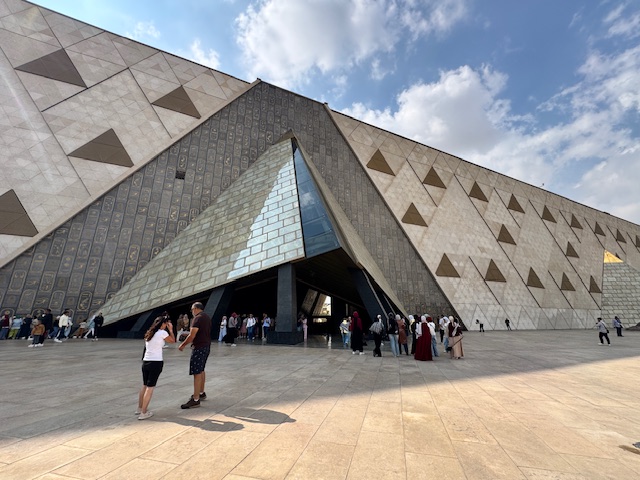
Assuming that your Uber or taxi dropped you off at the main gate, head over to the security screening gates. Bags need to be screened before being allowed to enter the museum grounds. If you come directly from the airport or have a large bag that you do not want to lug around, you can drop it off at the security office and collect it later when you are done. To find the security office, look over your left shoulder as you are facing the security gates and you will see the big sign.
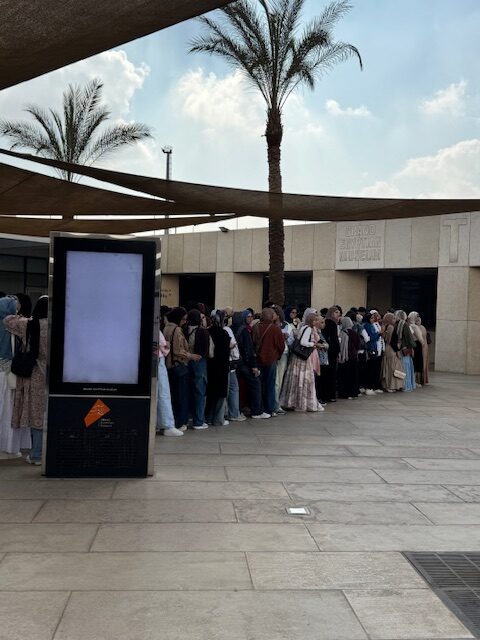
Past the security gates are the ticket counters. You can buy the entry tickets here or on-line. We would recommend buying on-line. The on-line ticket will have a QR code that needs to be scanned. It will also show an 8AM time slot if you bought the ticket a day or more prior to the visitation date. It does not mean that you have to be there at 8AM. We went in around 11:30 AM.
Entering The Museum
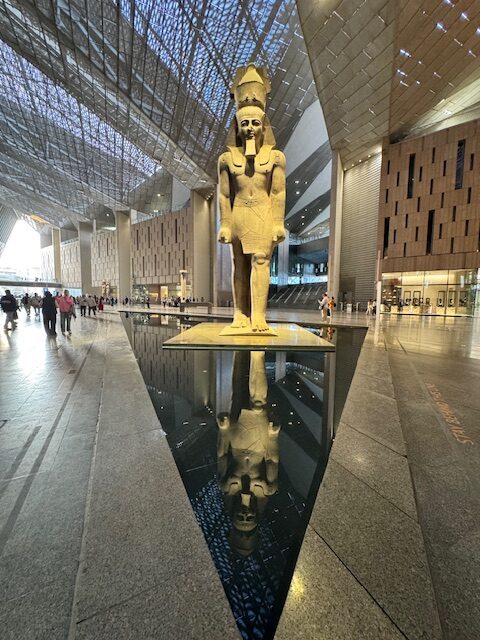
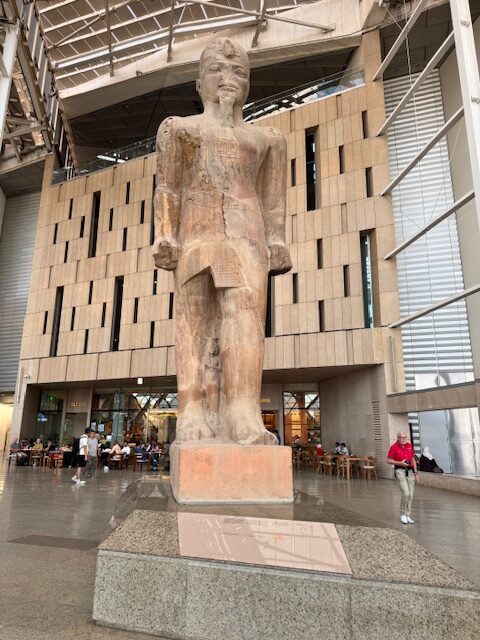
Upon entering the museum’s main door, you will be welcomed by the 3,200 year old giant statue of King Rameses II. There are information desks to the left and right where you can obtain a museum map. Head over to the back and look for the stairs and escalators to your left to go to the exhibit areas.
A funicular located between the stairs and the escalator is provided for wheelchair bound people to get to the exhibit areas.
Galleries (Exhibit Areas)
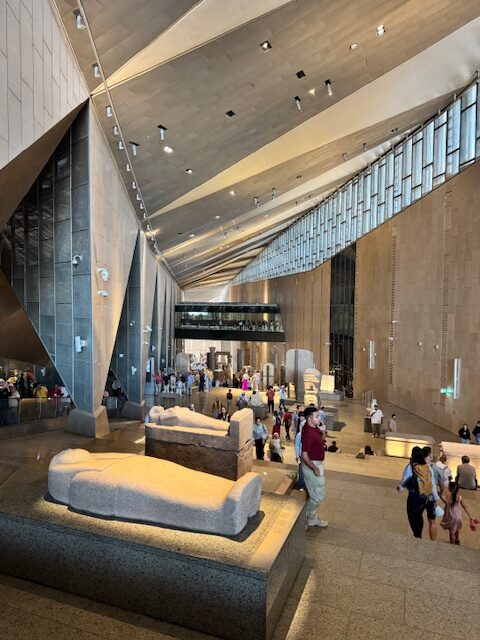
The galleries (exhibit areas) are located in the third level. You can take the inclined moving walkway or the stairs to get to the exhibit areas which is at the third level. Turn left at the end of the inclined moving walkway or stairs to enter the Main Galleries. Do not turn right as that is the King Tut gallery exit. This is where visitors are supposed to exit after going through the galleries.
Main Galleries
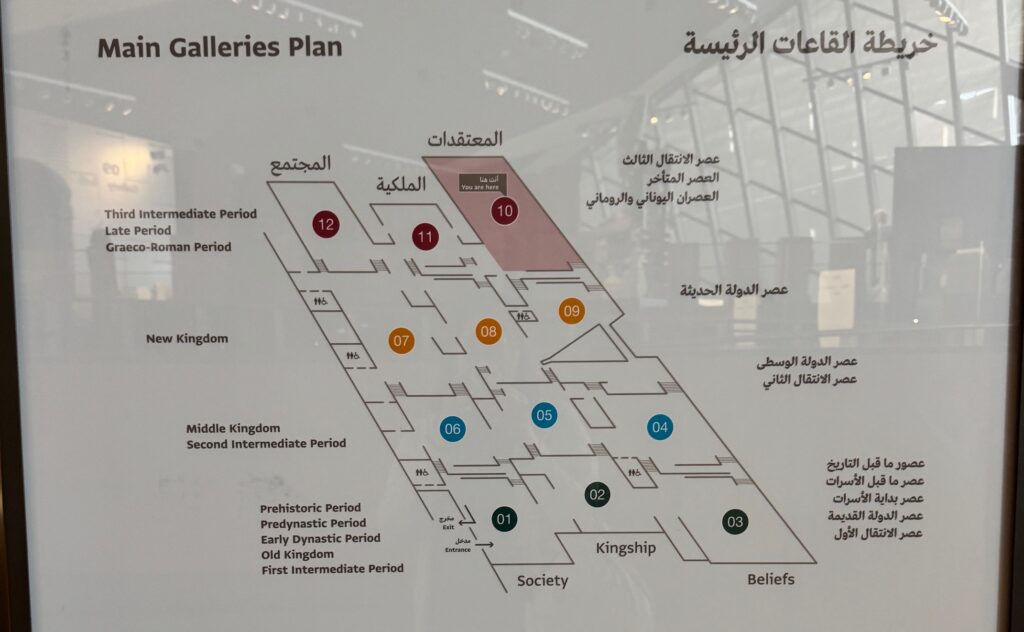
The Main Galleries is divided into three halls which are Society, Kingship and Beliefs. Each hall is further divided into four time periods with the oldest being (Pre-historic era) at the front and the youngest (Greco-Roman era) at the back. So there are a total of 12 galleries.
The galleries for different time periods are not at the same level. The Greco-Roman era is at the lowest level and the Pre-historic era is at the highest level. You have to tackle a few stair steps to move from one time period within a hall. They did make the galleries of the same time period at the same level across the three halls, i.e. the same color numbered galleries on the map are on the same level (see photo).
To efficiently (least amount of walking) see the Main Galleries, it is best to move laterally across the halls by following the numbered areas (see photo). This way, you see the exhibits in the same time period among the three halls before moving on to the next time period. This also means that you are going down and not going up any stairs.
Once you reach the Greco-Roman era of the Society hall (#12), double back and look for the bridge to the King Tut exhibits. Work up the exhibits until you reach the King Tut exhibit exit.
You will be saving the best for last with this path as the King Tut’s gold mask is located near the exit (please continue reading the next section).
King Tut Exhibit
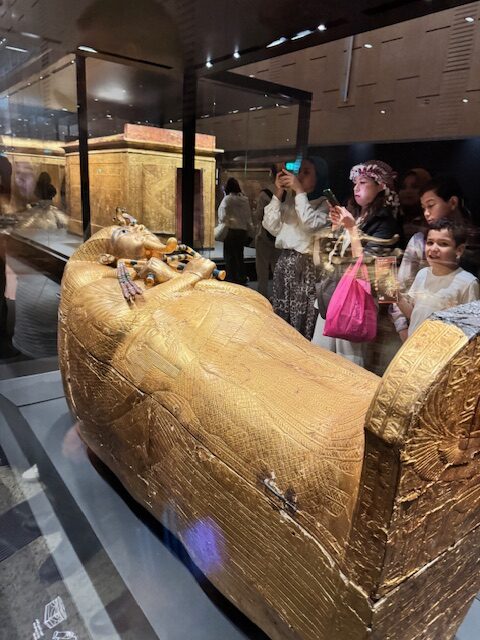
An entire hall is dedicated to the Treasures of King Tut. This hall is undoubtedly the busiest. Here you will see the king’s three coffins and four shrines among many other artifacts. The coffins and shrines are nesting, meaning one is larger than the other so that the smaller coffin or shrine will fit into the next one. The exhibit notes indicate that the smallest coffin is made out of pure gold.
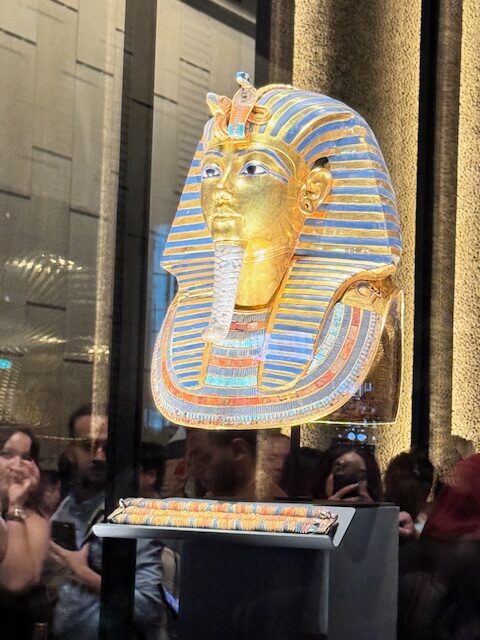
Undoubtedly, the Mask of King Tut is the most popular. This is located by the exit area or towards the front of the museum. They set-up a viewing lane for the mask so that people do not have to crowd in front of it. Once in front of the mask, you only have a few seconds before you are ushered on to keep the line moving.
Pyramids Viewing Area
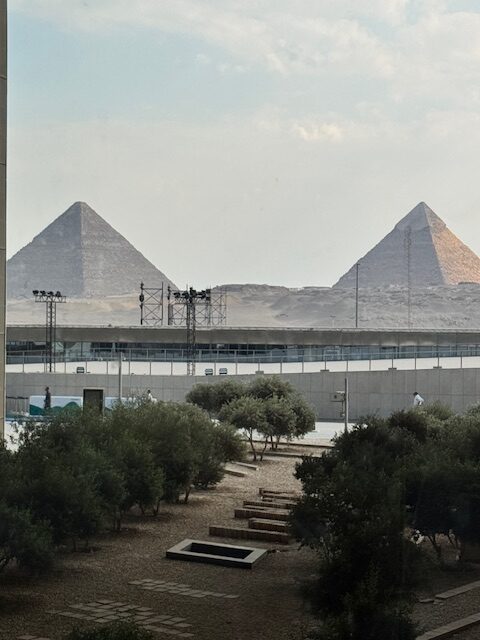
At the entrance end of the three exhibit halls are benches where you can admire the three Great Pyramids of Giza from a distance. The best viewing area, in our opinion, is at the end of the Belief’s Hall as it provides the most unobstructed view.
Solar Boat Exhibit
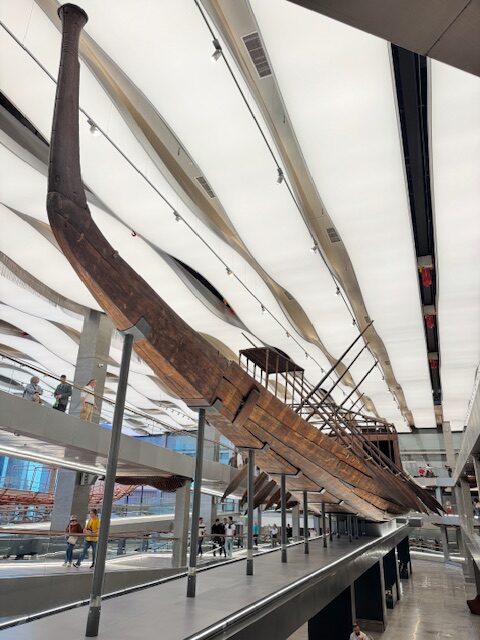
Behind the main building is another building that shows the solar boat excavated from the foot of King Khufu’s pyramid (described later). This solar boat is about 43 meters (142 feet) long. A solar boat is a ritual vessel. The boat symbolizes the means for the deceased king to travel into the afterlife.
Pyramids of Giza
The Pyramids of Giza can be done with or without a tour guide. Despite the dreaded information overload, we used a tour guide for two reasons. First – the half day tour was inexpensive. Second – we thought that being with a tour guide would spare us from being harassed by locals wanting us to buy a souvenir or ride a camel. The latter turned out to be true though we could have easily said no to any offerings as we were used to saying it when we were in Luxor.
We selected a guide and car with the option to buy on our own the entry tickets. We were picked up at 7AM and dropped off at our hotel around 10:30 AM. Going early has its advantages. Besides being done before it gets hot, there are a less people than during the middle of the day when the large tour buses starts pouring in.
Our tour may not seem a long time but there was really not much to see and do at the pyramids unless you partake in other activities such as camel or horse rides. Our guide also provided a lot of information to recall. After the pyramids, we stopped at the papyrus shop where we learned how papyrus is made and where you can purchase nice papyrus souvenirs.
The Great Gate
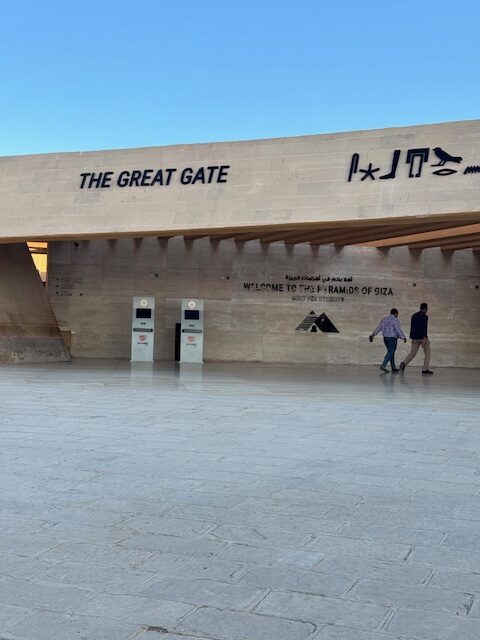
The main entry to the Pyramids of Giza is called The Great Gate. This is where our driver dropped us off with our guide. This is also where we purchased our entry tickets. The Great Gate is also a visitors’ center which has exhibits and posted information about the pyramids. Then we rode the shuttle bus once we exited The Great Gate.
Panorama
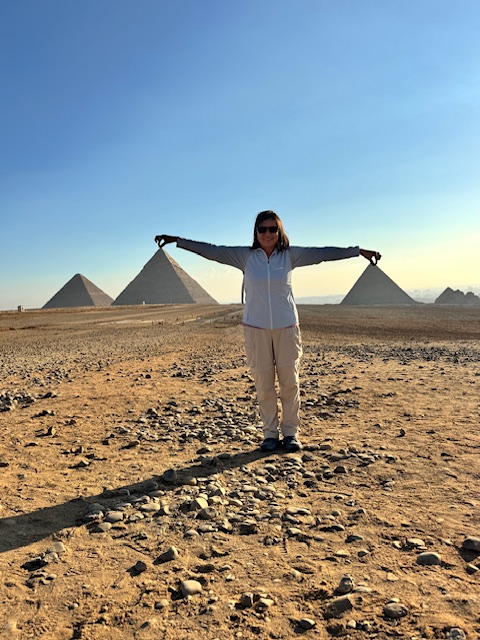
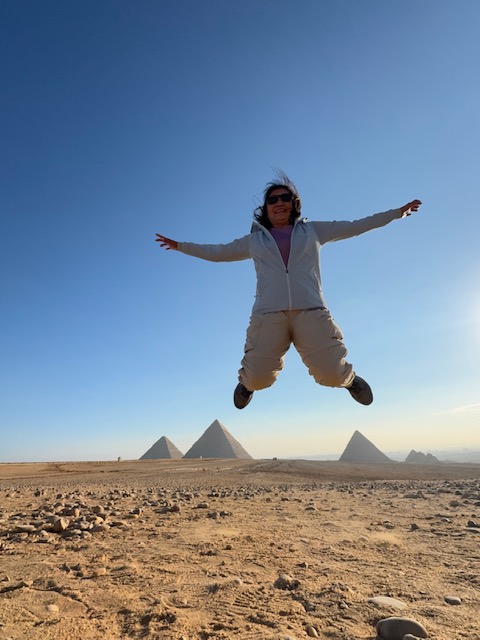
We got off at the first stop which was the Panorama. This is where our guide took some camera trick photos with the pyramids in the background.
Pyramid of King Khufu
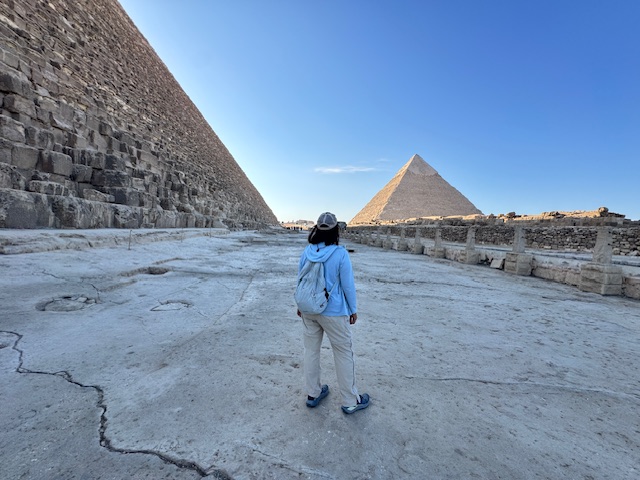
We boarded the shuttle bus and got off at the third stop which is between the Pyramids of King Khufu and King Kafre. Then we walked over to King Khufu’s pyramid. Most of the pyramid is roped off but we could get close to see the massive rocks at the base.
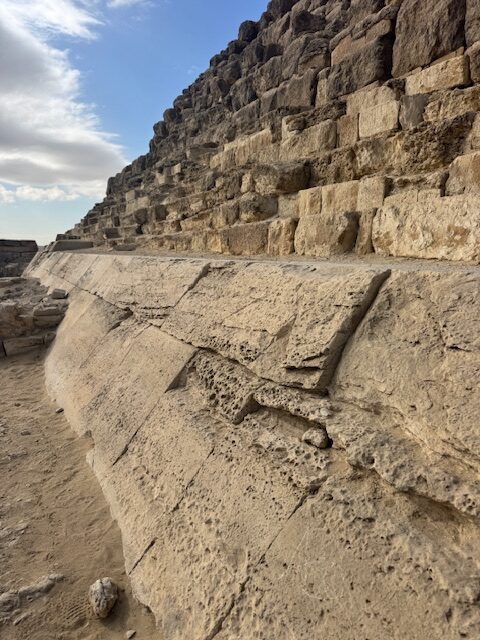
Our guide pointed to the remaining casing at the tip of King Khafre’s pyramid. He said that the great pyramids used to be covered with polished limestone casings. This provided a smooth exterior finish.
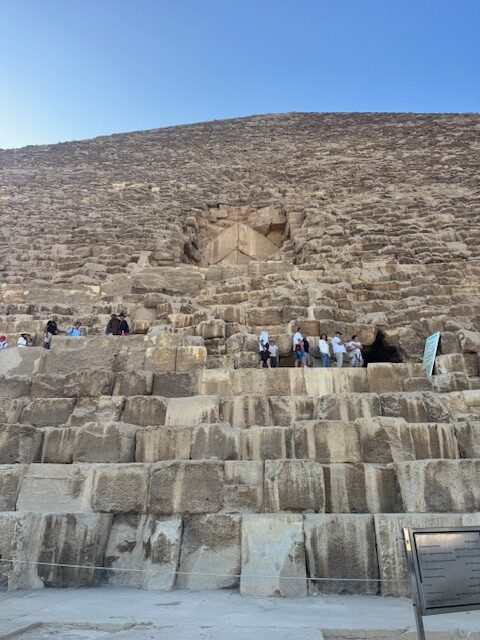
We then walked over to the north side of King Khufu’s pyramid. This is where we were able to climb partway up the pyramid. This is also where you can get inside the pyramid through a narrow passageway. Entry to King Khufu’s pyramid requires a separate entry ticket. Our guide said that there was really nothing much to see inside the pyramid especially of that we have been to the Valley of the Kings in Luxor.
Smaller Pyramids
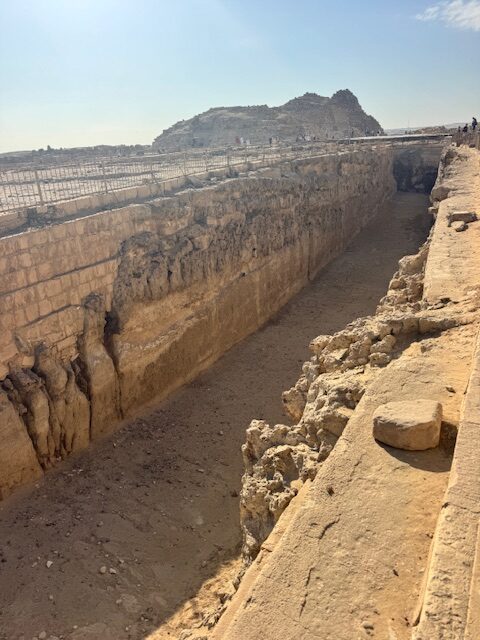
We then walked over to the north side of King Khufu’s pyramid. Our guide pointed out where the solar boat that is displayed in the GEM was excavated.
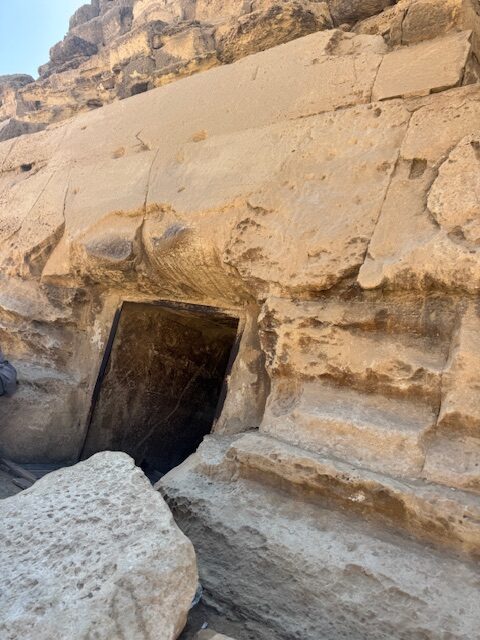
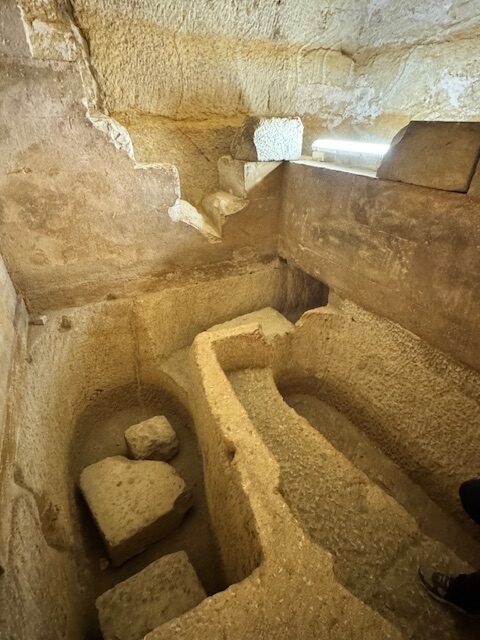
Our next stop was to one of the smaller pyramids northeast of King Khufu. This smaller pyramid has an access tunnel that was free to enter. We just had to wait our turn as the passageway was only wide enough for one person. There was really nothing to see inside the pyramid except a small empty chamber. There were no colorful hieroglyphics or paintings.
Sphinx
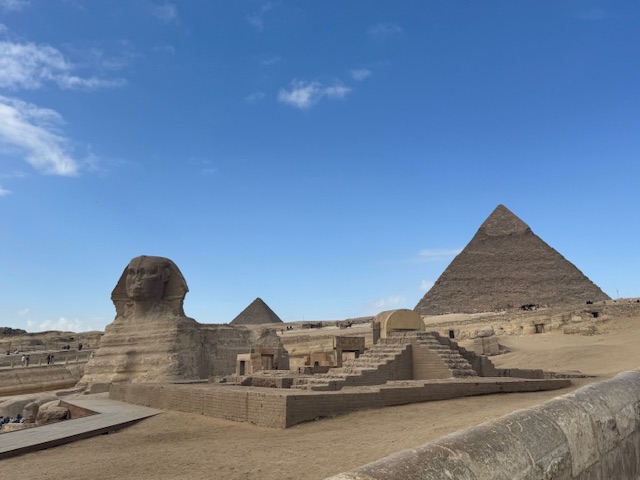
We finished the pyramids tour by walking over to the lone great sphinx viewing area. We essentially viewed the sphinx from behind the fence. Entry beyond the fence is not included with the regular entry ticket. Our guide said that you have to be in a private tour to go beyond the fence and have the opportunity to have your photo taken in between the sphinx paws. However, these private tours are ridiculously expensive.
Papyrus Shop
Our last stop was the papyrus shop. We learned (at the time, now we cannot recall) how the papyrus is processed to make paper. This informative sesssion was short. Our guide said that a paper made from papyrus is thick and that the cheap ones are made of banana leaves. We spent a lot of time admiring the papyrus artwork displayed in the shop.
How To Get There
GEMS: Uber. Note that the Uber pick-up point (once you are ready to leave) is not the same as the drop off point. The Uber pick-up point is more in front of the GEMS rather than at the entry gates. We had to walk about 200 m against the traffic to the designated pick up point.
Pyramids of Giza: As described earlier, our tour picked us up and dropped us off at our hotel. Because Uber works in Cairo, there is no doubt that you could use this rideshare to get you to the Pyramids of Giza entry gate.
Where To Stay
We stayed at the Holiday Inn Cairo Maadi by IHG which is by the Nile River. This is not to be confused with another Holiday Inn Maadi which is away from the river.
The hotel has a couple of in-house restaurants and the menu prices are reasonable. The Panda Supermarket is five minute walk from the hotel. This is a well stocked supermarket.
How to Get Around
GEMS: Walking.
Pyramids of Giza. Shuttle bus.
The pyramids area is huge. Fortunately, there is a shuttle bus that operates to take people around. The shuttle ride is included in the admission price. The bus has four stops. We got off the first and third stops. The first stop is the panorama point. The third stop is between King Khufu and King Khafre pyramids. The second stop is basically in front of King Khafre pyramid but our guide skipped it. The fourth stop is by the sphinx but we just walked from the pyramids to the sphinx which was not that far.
We exited through the back gates of the Pyramids of Giza where we got picked up by our tour driver instead of returning to the main entry gate.
Expected Expenses
GEMS – 2,900 EGP (on-line purchase)
Pyramid of Giza Entry: 700 EGP/pp (crefit card accepted)
Pyramid of Giza Tour (Viator): $30 (two people)
Stay Informed
If you want to be notified when we post a new travel story, please enter your email below. We respect your privacy. Your email is used only to notify you of new posts and is never sold or shared with third parties. You can unsuscribe at any time.
Summary
The GEMS and Great Pyramids of Giza are a must visit while in Cairo. The GEMS contains thousands of Egyptian exhibits from the pre-historic era to the Greco-Roman era. You will spend hours just looking at the exhibits. The GEMS was packed during our visit as it just recently opened.
Across the road from the GEMS are the Great Pyramids of Giza. Three great pyramids still stands surrounded by six smaller pyramids. It is fascinating to see these monuments up close. You just cannot help ask the question “how did they do that?”
Both the GEMS and the pyramids can be seen in a day. If you start with the pyramids early in the morning like we did, you would have enough time to see the GEMS in the afternoon. Whatever you decide, we are confident that seeing these two places would give you a deeper appreciation of Egyptian history.